The Postcard Before the Camera Roll
The postcard before the camera roll paired a travel image with a brief note. Learn how its design shaped what senders shared and what recipients could infer.
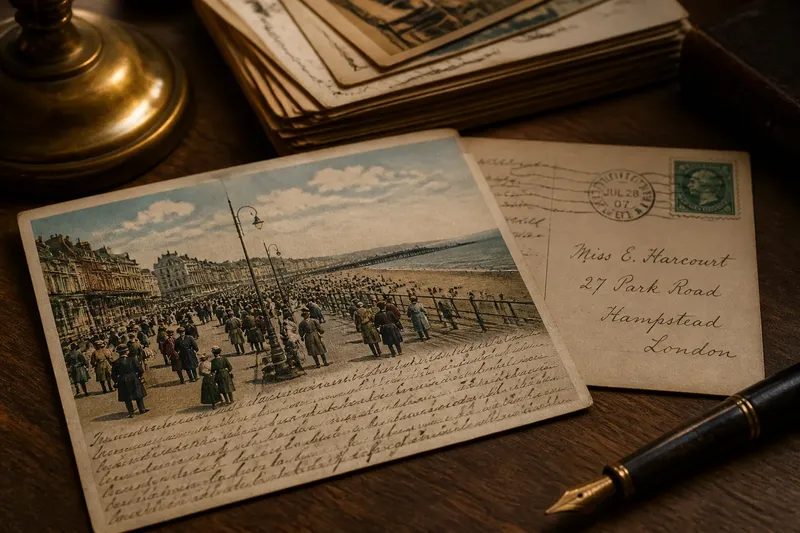
The most common mistake in reading an old travel postcard is to assume its picture records a traveler’s exact experience. That assumption can turn a selected, saleable view into a false itinerary. The postcard before the camera roll was a designed object: its image, writing space, and postal marks each served a different purpose.
The postcard before the camera roll combined display and correspondence
A postcard had to survive ordinary postal handling while carrying a picture and a message. Its exposed writing made it unlike a sealed letter: postal workers and other handlers could see the note, so the sender’s words traveled in public.
The image side presented a place, while the reverse carried words and an address. This compact arrangement let a recipient recognize a destination and receive a personal greeting in the same object. It also shaped the message: a postcard offered room for a quick update, not an extended account.
A postcard picture is a publisher’s selection
Begin with what the image emphasizes. A landmark makes a destination recognizable; a street scene gives it a more everyday scale; a harbor or broad landscape can suggest movement or distance. These are choices about how to present a place, not neutral records of everything a traveler encountered.
Then notice what falls outside the frame. A printed view may highlight an attraction and omit the station, the route, or ordinary surroundings. The sender might have bought the card locally, so the image alone does not establish where that person stood or what they saw.
Captions and publisher names offer further clues about how a place was packaged for viewers. A caption can identify a scene for someone far away, while a publisher’s title may present a local view as a recognizable souvenir.
The back’s layout shaped what senders could write
Turn the card over and look at how the message and address share the space. On some older cards, the address took up the reverse, leaving the picture side available for a note. A divided back later provided separate areas for address and message, making the reverse easier to use.
The layout did not simply organize handwriting; it set limits. A sender working around an address or a printed caption had to choose what mattered most. Even a divided back left little room compared with a letter, so greetings and timely details often took priority.
Look for writing that crosses an image, crowds a margin, or fills an open patch. Such marks show how the sender adapted to the particular card rather than writing on an abstract, uniform surface.
The message reveals a moment, not the whole relationship
A greeting, an arrival note, or a promise to write later can reveal why the sender chose to make contact at that moment. A short message does not by itself show that a relationship was casual; the card’s space and public format also shaped what could be said.
Notice what the sender names and what the image supplies instead. A familiar view might need little explanation, while a note about a companion or next stop can add information absent from the printed scene. The gap between text and picture is part of the card’s meaning.
Imagine a traveler buys a card showing a crowded seaside promenade, then writes, “Arrived safely; I’ll write more soon,” before mailing it to a relative. Reading the card, you can identify the printed promenade, the sender’s arrival update, and the promise of a longer message; you cannot infer that the sender stood at the exact spot pictured or learn what the rest of the visit involved.
Postal marks and addresses describe different parts of a card’s movement
A postmark can indicate where a card entered the mail, while the address identifies its intended recipient. Neither alone establishes where the image was made, where the sender began traveling, or how the card moved before and after that postal point.
Keep place names separate when they differ. A card could be purchased in one town, show another place, and be mailed from a later stop. Describing each clue on its own avoids turning several partial signals into one unsupported route.
- If the picture caption names a place, record it as the scene the card claims to show; if the image has no caption, describe visible features without assigning a location.
- If the postmark is legible, note its place name as a mailing clue; if it is unclear, mark the mailing location as unknown rather than guessing.
- If the address names a recipient’s town, treat it as the destination for delivery; if the address is incomplete, leave the intended destination uncertain.
- If the handwriting mentions arrival at a named place, record that as the sender’s statement; if it names no location, do not supply one from the picture alone.
- If a publisher’s name or title appears, distinguish it from the sender’s handwriting; if no publisher is identified, describe the image without attributing its selection.
- If the note refers to a companion, meal, or future stop, preserve that detail as written; if it says nothing about these, do not infer the sender’s company or plans.
These distinctions help describe what the object supports without pretending it gives a complete itinerary.
What can a travel postcard tell you?
Does the postcard image show exactly what the sender saw?
Not necessarily. It shows an image selected for the card, which may not match the sender’s exact vantage point or surroundings.
Why are postcard messages often brief?
The available writing space was limited, and the card was suited to quick correspondence. Brevity may reflect the format, the sender’s immediate purpose, or both.
What does a divided back indicate?
It indicates that the reverse had separate areas for the message and address. That arrangement clarified where each belonged without making the card equivalent to a letter.
Can a postmark reveal the entire route?
No. It can offer a clue about where the card entered the mail, but the picture and address concern different parts of its story.
Keep the postcard’s separate voices distinct
When describing a postcard, distinguish the printed image, handwritten message, layout, address, and postal marks before drawing conclusions. The image may present a destination, the message may update a recipient, and the postmark may identify a mailing place; none automatically speaks for the others.
The postcard before the camera roll joined a public view to a private gesture, though the message itself was visible in transit. Its value lies partly in that combination: a prepared image, a sender’s brief choices, and a small object that connected one place with someone elsewhere.