A Family Recipe, Rewritten for a New Cook
Rewrite a family recipe for a new cook with clear actions, sensory cues, and room for household variations, so the dish stays usable without losing its character.
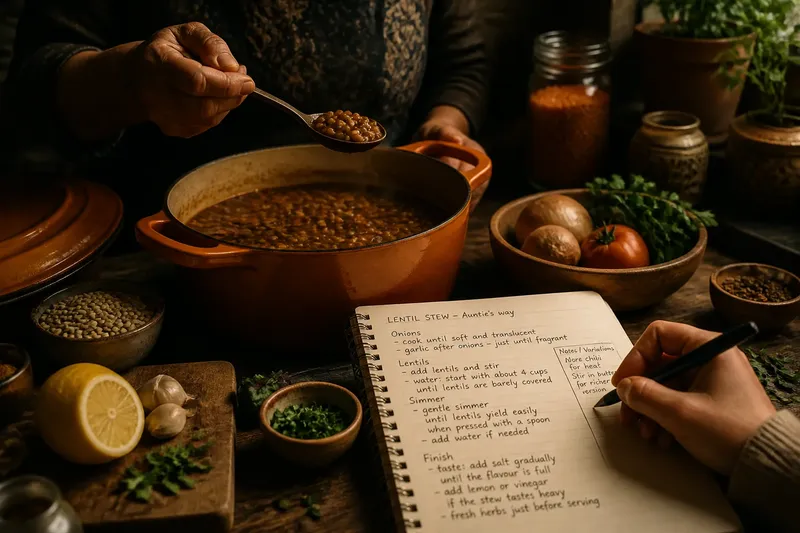
The most common mistake in rewriting a family recipe is replacing every “until it looks right” with an exact number. That can make the page seem clearer while removing the signs a new cook needs to make good decisions. A family recipe rewritten for a new cook should explain what to do, what to watch for, and which choices still belong to the person cooking.
A useful recipe is not a transcript of someone’s hands. It is a set of clues that helps another person recognize the dish as it takes shape. Keep the cook’s sensory language, arrange the actions in the order they happen, and make uncertainty visible instead of disguising it as precision.
Collect the cook’s cues before drafting
Ask the person who knows the recipe to talk through it without trying to sound formal. Invite them to describe what they notice: the smell of onions before adding tomatoes, the feel of dough when it stops sticking, or the sound of a simmer that is too lively.
Write down their words as they say them, including phrases such as “a good handful” or “until the oil separates.” These may seem imprecise, but they often point to observable changes. Ask what the cook sees, smells, hears, or feels at that moment.
Keep a separate note for choices that vary between households or occasions. A cook might use more chili for one table, or add lemon when the tomatoes taste especially sweet. Recording those choices is different from declaring one version incorrect.
Put remembered actions in cooking order
Arrange the actions in the order they happen. Start with preparation, then group the cooking into phases such as softening aromatics, building the sauce, simmering, and finishing. A reader should not have to guess whether to chop the herbs before the pan is hot.
For each action, note its purpose and the clue that signals what comes next. “Cook the onions until soft and translucent” is more useful than “cook the onions for a while” because it pairs an action with a visible cue. If the cook says the onions should be golden instead, preserve that distinction rather than silently choosing one.
Separate ingredients that go into the pot at different times. “Spices” may mean cumin at the beginning and fresh cilantro at the end; combining them into a single line can change the flavor and confuse a beginner.
Use quantities where they clarify a decision
Identify the details that benefit from quantities: the main ingredients, the cooking vessel, and any proportions that hold the dish together. If the cook uses a teacup as a measure, describe the cup’s role plainly or record a familiar kitchen measure alongside it. Do not imply that a family’s customary scoop is a universal standard.
Use numbers where they help someone begin, but pair them with sensory guidance when ingredients vary. “Add the stated amount of water, then check whether the rice is just covered” gives a reader both a starting point and a way to respond to a different pot or grain. Avoid adding precision that no one in the household can explain.
When a detail depends on the food package, equipment, or local food-safety guidance, follow the relevant label or manufacturer instructions. For handling and cooking foods that require particular care, consult appropriate guidance rather than relying on memory alone.
Write actions a first-time reader can follow
Draft each instruction with a clear action and a useful cue. Put the ingredient near the moment it is used, and name the pan or bowl when switching equipment. Replace “do this as usual” with the actual action, even if the family has repeated it for years.
Keep a brief note beside the recipe for meanings that need context. “A handful of mint” might refer to leaves loosely gathered in one hand, not packed down. “Let it rest” might mean leaving the pot covered away from the heat so the grains finish steaming.
Say you are writing down an aunt’s lentil stew. She remembers adding water until the lentils are barely covered, then simmering until they yield easily when pressed with a spoon. You write a starting amount of water from her account, preserve “barely covered” and “yield easily” as checks, and note that the reader should add water if the lentils stop being covered before they soften; the resulting instructions give a newcomer both a starting point and a clear adjustment.
Keep some instructions open on purpose
Mark which details are stable and which are invitations to adjust. A stable detail might be adding garlic after the onions have softened so it does not scorch. An open detail might be whether to finish with vinegar, lemon, or no acid at all.
Open language should still help the reader decide. Instead of “season to taste,” explain what the seasoning is meant to balance: add salt gradually until the beans taste full, or add acidity if the sauce feels heavy. The cook remains free to choose, but has a reason to guide the choice.
Preserve meaningful variation by naming it. “For a richer version, stir in butter at the end” makes room for a family preference without presenting it as mandatory. Keep corrections and alternatives beside the relevant step, not in a long memory note that a cook cannot use while stirring.
How should uncertain details appear in the recipe?
What if the remembered amount changes each time?
Record a useful starting point and the cue that tells the cook to stop or continue. If no one can explain the amount’s purpose, describe the uncertainty rather than inventing a precise quantity.
Should family stories appear in the recipe?
Include a short story when it explains a choice, such as why the dish is served with plain yogurt. Place longer recollections in a separate note so the cooking sequence stays easy to follow.
How can a new cook tell when a dish is ready?
Use cues the cook can observe, such as texture, aroma, color, or the way a sauce coats a spoon. When readiness also involves food safety, rely on appropriate guidance for the specific ingredient rather than a family memory alone.
What belongs in the recipe’s margin?
Put optional substitutions, family variations, and reminders about unfamiliar terms there. Keep essential timing and safety information in the main instructions, where it cannot be mistaken for a casual suggestion.
Check the finished page for gaps and unclear choices
Read the recipe aloud and check that every pronoun has a clear subject: “add it” should identify what “it” means. Look for ingredients that never appear in the method, actions with no stated cue, and steps that ask a beginner to make two decisions at once.
Ask someone who has not cooked the dish to read the draft and mark each point where they would pause. A pause can reveal a missing transition, an unfamiliar term, or a choice that deserves to remain open.
A family recipe rewritten for a new cook works best when its page holds both instruction and room for judgment. Keep the inherited cues in the language, make the sequence legible, and identify the choices that are part of the dish’s living tradition. When revising a family recipe for a new cook, preserve the signs that help the next person respond to the ingredients in front of them.